Public Policy Featured Resources
July 23, 2026
MNA is asking our member organizations to sign a letter to our federal delegation, asking…
March 10, 2026
P.S. Trying to figure out how this may impact your fundraising in 2026 and beyond?…
September 04, 2025
The federal reconciliation package passed this summer – also known as the “One Big Beautiful…
October 09, 2025
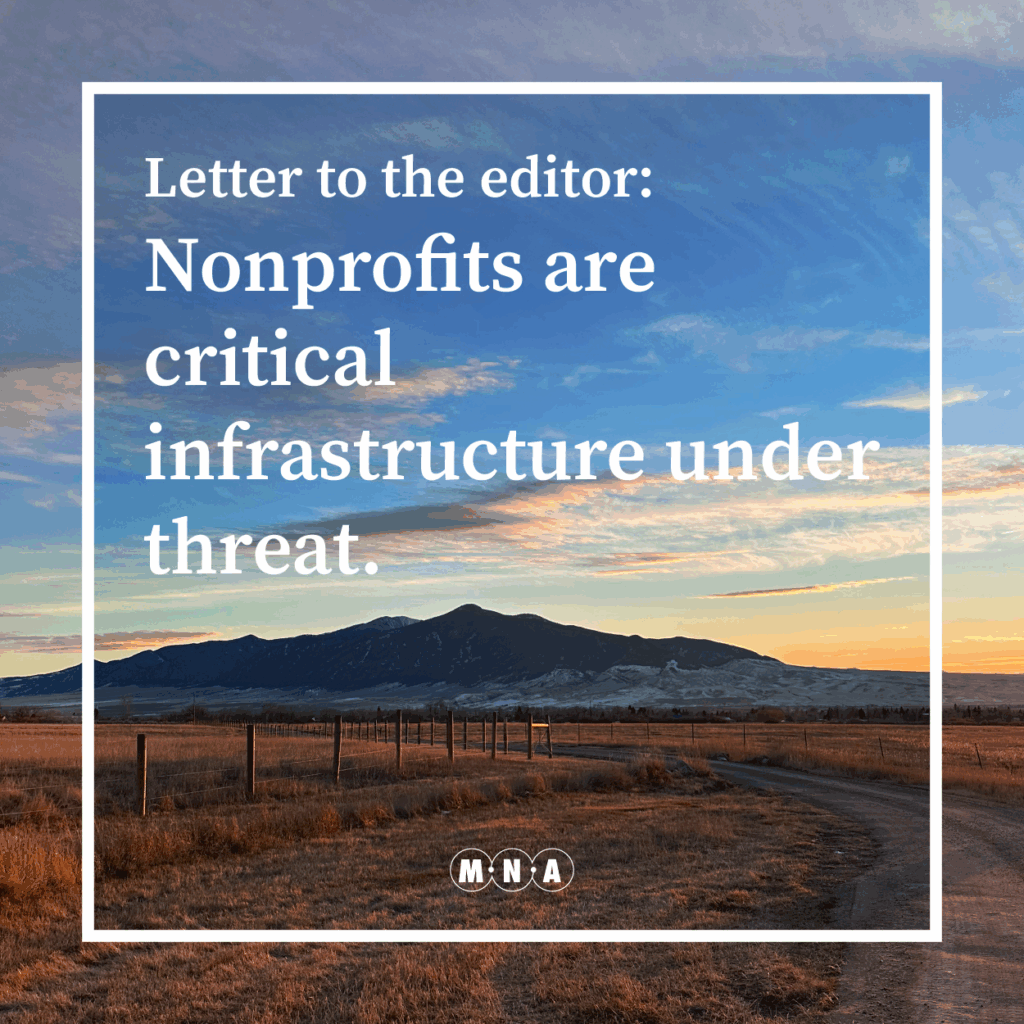
This letter to the editor was submitted to newspapers in Montana on October 9, 2025…

August 20, 2024
One of the most powerful ways to educate and engage your community on an issue…
February 04, 2026
Like so many of you, we are deeply concerned by the events unfolding in Minnesota and…
More questions? View all MNA Public Policy Resources here.
Public Policy Agenda
Montana Nonprofit Association’s public policy agenda represents our long-term framework for addressing public policy that impacts and strengthens nonprofits in Montana. The following agenda represents the core focus areas of MNA’s public policy work and was developed in consultation with MNA membership and the broader Montana nonprofit sector.
-
Nonprofit Practices, Reputability, and Accountability
Nonprofits can only be successful through earning and maintaining public trust. MNA promotes the ability of nonprofits to operate at the highest levels of integrity and transparency and be accountable to the public and communities they serve.
- MNA supports an appropriate level of government regulation and enforcement to protect the public’s interest while upholding the integrity of the nonprofit sector.
- MNA supports policies that protect the decision-making autonomy and self-governance authority of charitable nonprofits.
- MNA opposes policies that divide 501(c)(3) organizations based on mission, philosophy, or services provided.

-
Charitable Giving and Volunteerism
MNA recognizes that public generosity and engagement are essential to a strong nonprofit sector.
- MNA supports policies that promote philanthropy and incentivize charitable giving by individuals, businesses, and organizations.
- MNA supports policies that support integrity in philanthropic practices and balances transparency with donor rights.
- MNA advocates for policies that support and promote volunteerism.

-
Tax Treatment of Nonprofits
MNA promotes and advances policies that preserve tax exemption of nonprofit organizations.
- MNA supports policies that protect tax-exempt status in recognition of the value nonprofits bring to society and communities.
- MNA opposes the imposition of taxes, fees, payments in lieu of taxes, or other costs that place undue burden on nonprofits or inhibit their ability to perform their work in the community.

-
Nonprofit-Government Relations
MNA improves and strengthens the essential partnership between nonprofits and local, state, and federal governments in Montana.
- MNA supports opportunities to improve access to state funding for nonprofits, including through more accessible and efficient grant and contracting processes.
- MNA supports contracting processes that recognize the strengths and vital role of community-based organizations in providing services and meeting local needs.
- MNA supports policies and practices that ensure that those most impacted by government policies and regulations are included in the decision-making process.
- MNA supports practices that ensure government contracts and grants cover the full cost of expected nonprofit services, including indirect costs and a competitive wage base for nonprofit employees.

-
Workforce Development and Capacity Building
MNA advances policies and partnerships that strengthen and sustain the nonprofit workforce.
- MNA supports policies that ensure nonprofits are included in statewide workforce development initiatives.
- MNA supports government investment in nonprofit capacity building, technical assistance and support, and nonprofit infrastructure.
- MNA supports programs and employment practices that promote employee health and well-being and create a competitive and sustainable nonprofit workforce.

-
Advocacy and Lobbying Rights
MNA protects the advocacy and lobbying rights of 501(c)(3) organizations and encourages Montana nonprofits to engage in nonpartisan advocacy activities to advance their missions.
- MNA supports policies that ensure 501(c)(3) nonprofits can advocate fully and freely within the law, and corrects misperceptions regarding lobbying laws and regulations for nonprofits.
- MNA opposes policies that restrict the advocacy rights and responsibilities of nonprofits.
- MNA supports measures to preserve and protect nonpartisanship in the work of charitable nonprofits.

-
Civic Engagement
MNA supports policies and activities that promote the ability of nonprofits and the people they serve to participate in the institutions and processes of democracy.
- MNA supports policies that protect and increase the ability of Montanans to exercise their voting rights.
- MNA advocates for and engages in outreach to support a fair and accurate Census count.
- MNA supports policies that preserve the rights of nonprofits to participate in nonpartisan direct democracy.
- MNA supports transparent and accessible public participation in the policymaking process.

-
Budget – Revenue and Appropriations
MNA supports a budget structure, including both revenue and appropriations, that meets the needs of today’s, and tomorrow’s, Montana.
- MNA supports public investment in resources that equitably meet the needs of Montana’s people.
- MNA supports budget investments that advance public/nonprofit partnerships as an effective way to support local communities.
- MNA supports a fair and balanced tax structure that sustainably funds public programs and resources, and meets the needs of our state for the long term.
- MNA opposes broad budget cuts that harm communities and undermine the ability of nonprofits to deliver vital services.

-
Foundations for Strong Communities
MNA recognizes that Montana’s most pressing challenges require strong public policy solutions. These foundational issues shape community well-being, directly affect the nonprofit workforce, and influence the ability of nonprofits to carry out their missions. These priorities are intended to reflect current critical, statewide priorities and align with the broad, community-focused values of the nonprofit sector.
- MNA supports policies to increase access to affordable housing, strengthening the nonprofit workforce and sustainability of local communities.
- MNA supports policies that strengthen Montana’s childcare system, increasing access to quality, affordable care for Montana’s workers and families.
- MNA supports policies that protect and increase access to healthcare, including in rural communities.
- MNA supports policies that advance economic security for Montana families and workers.

Criteria for Implementing Advocacy & Public Policy
MNA focuses on issues that affect the entire nonprofit sector or a vast majority of the sector, or that are determined to have statewide policy significance. Additionally, MNA may offer awareness-building support for subsector issues, sharing information and facilitating opportunities for organizations to engage directly on issues impacting their missions.
The following criteria will be used by the Public Policy Council in considering whether MNA should engage in policy advocacy on a particular issue:
Impact – Does this issue affect the interests of the nonprofit sector in a significant way? Would our involvement advance our mission?
Support – Is there, or do we reasonably anticipate there will be, general support among the members of MNA on the position to be taken?
Credibility – Would MNA as an organization be perceived as a legitimately concerned and appropriate advocate for the position to be taken? Would our involvement draw on our expertise, positioning, and knowledge?
MNA’s public policy efforts will encompass issues which:
- Have statewide application or effect; or
- Have local or limited application but are determined to have statewide policy significance;
AND
- Have general relevance to the creation, management, operation, administration, and well-being of nonprofit organizations in the State of Montana; or
- Are of broad, community-wide importance, and are likely to have such a significant impact on the people and causes nonprofits serve that it is appropriate for the voice of the nonprofit sector to be represented in the policy debate.
How MNA Engages on Policy Priorities
MNA’s work across our policy agenda will vary by issue and by bill. To clearly communicate our role and level of involvement, our engagement will be organized into three tiers. Each tier reflects MNA’s level of involvement, advocacy role, and allocation of time and resources. Depending on bill language and the development of a policy, an issue may move between tiers over the course of a legislative session.
Within each tier, MNA will determine a position on the bill or issue: Support, Oppose, Monitor
Tier 1: MNA plays a leading role in advocacy on these issues, devoting significant staff capacity and resources. Actions may include direct lobbying of policymakers, outreach to nonprofits to support engagement, and working with partners to develop and advance an overall advocacy strategy.
Tier 2: MNA will work in coalition to support organizations leading on these issues. MNA may provide testimony, amplify partner efforts, and share regular policy updates and opportunities to engage.
Tier 3: MNA tracks these issues without active engagement. These issues may impact specific nonprofit subsectors or be of general interest to the nonprofit sector. MNA may indicate a position to inform nonprofits about potential impacts but will not devote advocacy resources beyond tracking the legislation.
The MNA Public Policy Council
Hilary Shaw
SECRETARY | Montana Legal Services Association • Kalispell
Jim Bennett
CHAIR Gift & Estate Planning Director, Montana Community Foundation • Havre
Ned Cooney
Consultant, NedCooney.com • Big Fork
Adam Liberty
President, Billings Catholic Schools Foundation • Billings
Patrick Maddison
CEO, Flathead Industries • Kalispell
Jeff Mangan
Founder, Mangan & Bennion • Craig
Tori Matejovsky
Executive Director, Great Northern Development Center • Wolf Point
Aidan Myhre
Consultant, AM Consulting • Helena
Jamie Palagi
CEO, Intermountain • Helena
C.B. Pearson
Consultant • Missoula
Kaia Peterson
Executive Director, NeighborWorks Montana • Missoula
SK Rossi
Consultant, Central House Strategies • Helena
Mary Rutherford
President & CEO, Montana Community Foundation • Helena
Jono McKinney
President & CEO, Montana Conservation Corps • Bozeman
Jason Smith
Executive Director, Montana Consortium for Urban Indian Health • Helena
Emily Wolfram
Executive Director, Montana Performing Arts Consortium • Great Falls
Jenn Olson
Government Affairs Director, Montana League of Cities and Towns • Helena
Katie McLain
Executive Directpr, Montana Community Action Network • Florida
Leonard Smith
CEO, Native American Development Corporation • Billings
Rose Bender
Director of Research, Montana Budget and Policy Center • Helena
Apply to Join the MNA Public Policy Council
Montana Nonprofit Association (MNA) is seeking interested individuals to be part of our Public Policy Council, advising and informing MNA’s policy activities. The Council is made up of individuals with direct professional, volunteer, or personal experience in nonprofit advocacy and public policy. The Council works closely with MNA staff to create and implement a comprehensive policy agenda addressing the numerous policy issues that impact the nonprofit sector.
Function of the Public Policy Council
The Public Policy Council makes recommendations to the MNA Board of Directors on setting public policy goals and objectives of the organization. The Council advises and assists MNA staff in selecting appropriate policy issues and positions; in lobbying and advocating MNA positions; and in planning and implementing other activities related to the public policy objectives of MNA.
Application Process
Interested individuals should complete the form below. If you have questions, please reach out to Lorianne Burhop, MNA’s Policy Director at lburhop@mtnonprofit.org.